History
Listed buildings
Five listed buildings stand inside the district, four listed bridges meet it at the river, and St Mary's church and its churchyard are just outside. Each links to its entry on the official list.
Last checked · Report a correction
What listing means
A listed building is one judged to be of special architectural or historic interest and added to the National Heritage List for England, which Historic England keeps on behalf of the government. Listing covers the whole building, inside and out, and usually anything fixed to it or standing within its grounds from before 1948.
There are three grades. Grade I buildings are of exceptional interest; Grade II* are particularly important buildings of more than special interest; Grade II, by far the most common, are of special interest. Listing doesn't freeze a building, but changes that affect its character need listed building consent from the council, Gateshead here, on top of any planning permission.
Map loads when you scroll here. The links below open it in your own map app.
Brick pins are Grade I and II*, dark pins Grade II. Tap a pin to jump to the building. The bridges' pins sit mid-river, where the list places them.
In the district
-
Ochre Mews (the former Boiler Shop of Greenesfield works) Grade II
Listed 15 March 1979. Official entry: THE FORMER BOILER SHOP OF GREENSFIELD RAILWAY WORKS (list entry 1248971)
-
Wellington House (36 and 38 Half Moon Lane) Grade II
Listed 13 January 1983. Official entry: 36 AND 38, HALF MOON LANE (list entry 1277621)
-
Railway bridge by Station East Grade II
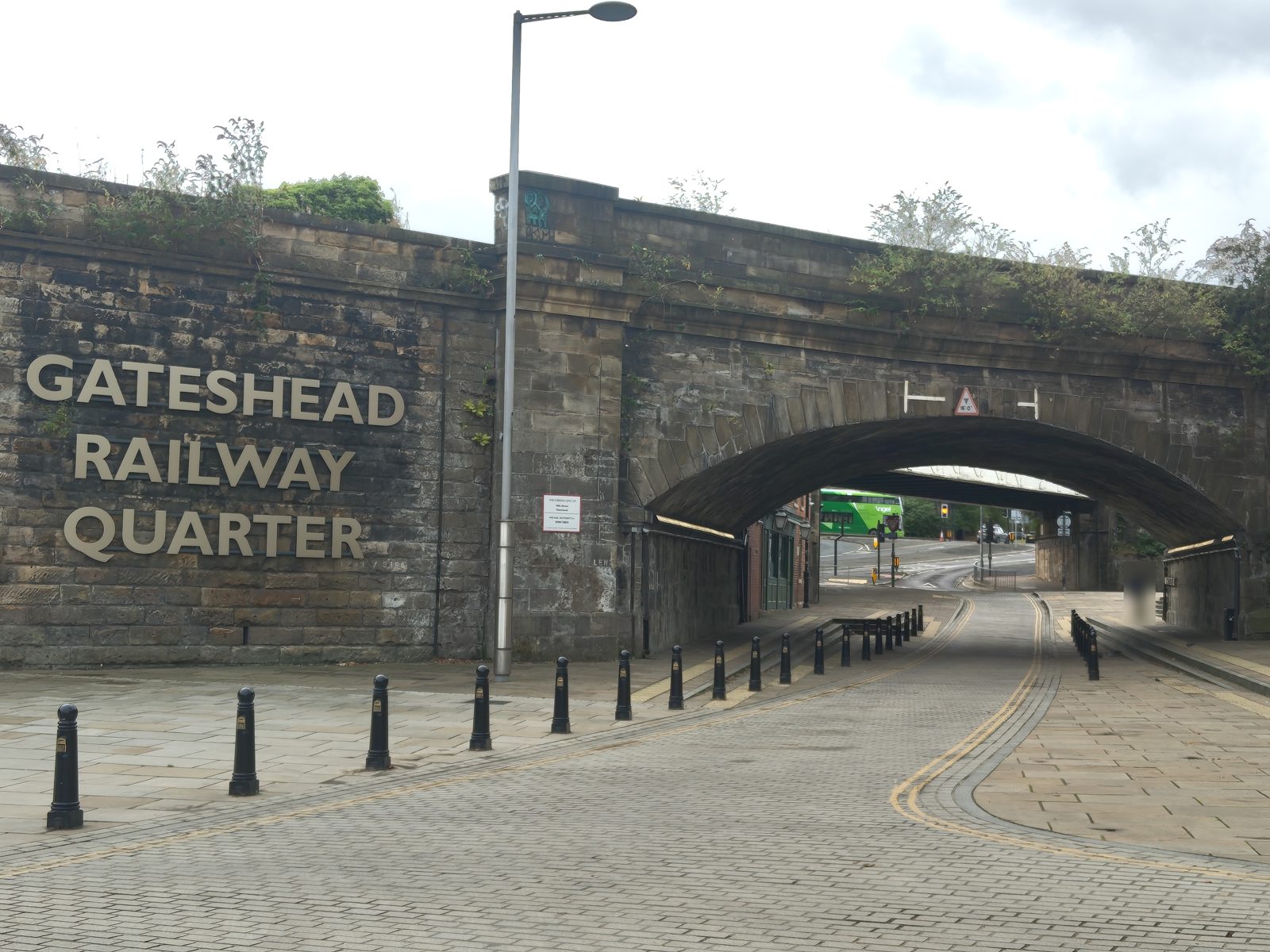
The bridge over Hills Street, Station East under it. October 2026. Listed 13 January 1983. Official entry: RAILWAY BRIDGE OF FORMER YORK, NEWCASTLE AND BERWICK RAILWAY (list entry 1248561)
-
The Central Grade II
Listed 13 January 1983. Official entry: THE CENTRAL PUBLIC HOUSE (list entry 1248558)
-
The former public convenience at the south end of the Tyne Bridge (now offices) Grade II
Listed 5 August 1981. Official entry: PUBLIC CONVENIENCE AT SOUTH END OF APPROACH SPAN TO NEW TYNE BRIDGE (list entry 1277869)
The bridges at the district's edge
-
High Level Bridge Grade I
Listed 26 April 1950. Official entry: HIGH LEVEL BRIDGE (list entry 1248568)
-
Tyne Bridge Grade II*
Listed 13 January 1983. Official entry: Tyne Bridge (also known as New Tyne Bridge) (list entry 1248569)
-
Swing Bridge Grade II*
Listed 30 July 2004. Official entry: SWING BRIDGE OVER RIVER TYNE (list entry 1390930)
-
King Edward VII Bridge Grade II
Listed 19 August 1994. Official entry: KING EDWARD RAILWAY BRIDGE (list entry 1242100)
Just outside
-
St Mary's Church (St Mary's by the Tyne) Grade I
Listed 26 April 1950. Official entry: CHURCH OF ST MARY (list entry 1248544)
-
St Mary's churchyard walls, gates and railings Grade II
Listed 5 August 1981. Official entry: WALLS, GATES AND RAILINGS AROUND ST MARY'S CHURCHYARD (list entry 1277794)
-
Mausoleum in St Mary's churchyard Grade II
Listed 5 August 1981. Official entry: MAUSOLEUM TO EAST OF CHURCH OF ST MARY (list entry 1248545)
-
Coal drops on the riverside Grade II
Listed 13 January 1983. Official entry: COAL DROPS (list entry 1248565)
From Historic England's National Heritage List for England (open data, Open Government Licence), updated 6 October 2026. The descriptions are on each official entry. Across the river, Newcastle's Quayside and Castle Garth have many more.