Heritage
High Level Bridge
Robert Stephenson's 1849 bridge over the Tyne, the world's first to carry a railway and a road on separate decks: trains on top, and below them a roadway for buses, taxis, people on foot and cyclists. It lands on our doorstep at the top of Wellington Street.
Last checked · Report a correction
| Address | Between Wellington Street, Gateshead, and Westgate Road, Newcastle |
|---|---|
| Street | Wellington Street |
| Open to the public | Yes |
| Confidence | C · confirmed |
Map loads when you scroll here. The links below open it in your own map app.
Entrance · South end (Gateshead), western footway, by the plaques
NZ 2526 6349 OS grid · 54.96545, -1.60697
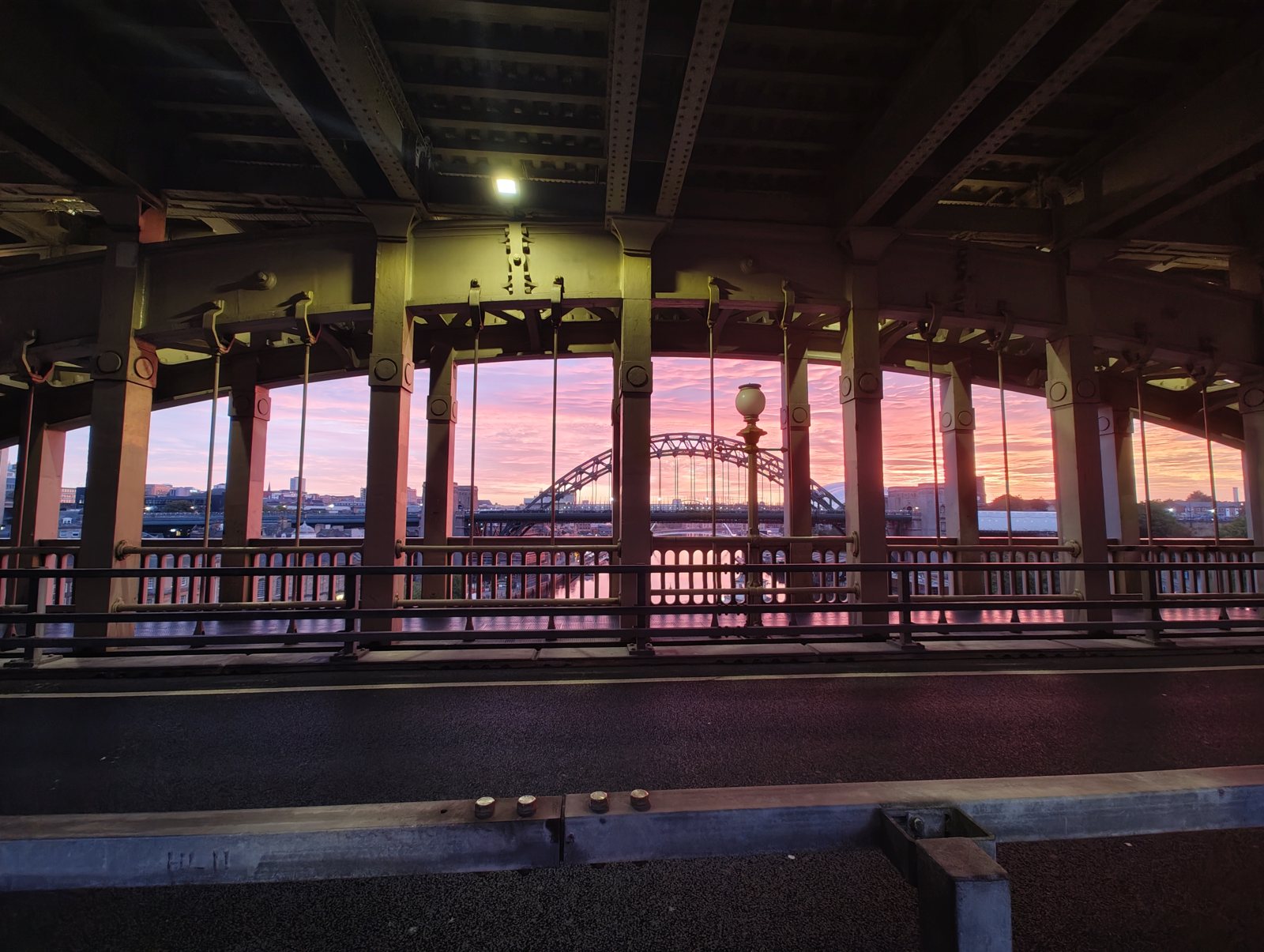
Using it
The upper deck carries the railway. The road deck below is southbound only, for buses and taxis; cars and vans have to use the Tyne Bridge or the Redheugh Bridge. Both footways are open to people walking, and cyclists can use it too. From the Gateshead end it lands at the top of Wellington Street and High Level Road, a couple of minutes from the flats. Network Rail’s contractor AmcoGiffen has a site office at the top of Half Moon Lane for routine maintenance; there is no major project under way. Any closures go on the bridge works page.
How it came to be built
In 1836 George and Robert Stephenson launched a scheme for a railway from London to Scotland by way of Birmingham, Derby, York and Newcastle. Under George Hudson, the “Railway King”, the line from Darlington reached Gateshead in 1844, ending at Greenesfield. To carry it on to Berwick, Hudson and Stephenson had to see off Isambard Kingdom Brunel’s rival atmospheric-railway scheme, which had the backing of the former Prime Minister Earl Grey. Hudson won over both Newcastle and Gateshead councils by promising a bridge that would carry a road and footpaths as well as the railway. The promoter was the Newcastle and Berwick Railway.
Robert Stephenson designed it. Thomas Elliot Harrison, a Sunderland-raised engineer who had rejoined Stephenson in 1841 for the line to Berwick, was responsible for the works and later became Engineer-in-Chief of the York, Newcastle and Berwick Railway. Work began in August 1847. The first train crossed on 15 August 1849, and Queen Victoria crossed ceremonially on 28 September 1849 on her way back to London from Balmoral. The roadway and footpaths opened on 4 February 1850. It was the first bridge in the world to carry road and rail traffic together, on two decks.
How it is built
The river is more than 150 m wide here, with up to 12 m of silt over the bedrock. Each of the slender stone piers stands on wooden piles 12–18 m long, driven through the silt with James Nasmyth’s new steam pile driver. There are six spans of 125 ft (38 m), 1,338 ft (408 m) in all, with the railway about 120 ft above high water and the road about 96 ft.
Each span has four cast-iron arches, tied at road level by wrought-iron chains so that the arches don’t push outwards on the tall piers: a bow-string, or tied-arch, design. The railway sits on cast-iron columns on top of the arches, and the roadway hangs from them on wrought-iron ties. Although Stephenson had used the design since 1836, each arch was first put up in the contractor’s yard and proof-tested before it went into the bridge.
The ironwork, some 5,000 tons, came from Hawks, Crawshay and Sons of Gateshead, helped by John Abbot and Co. and Losh, Wilson and Bell. Stephenson’s instructions were strict: nothing was to depart from his drawings without his written permission. The masonry was by Rush and Lawton on the Newcastle side and Wilson and Gibson on the Gateshead side, largely in stone from near Heddon-on-the-Wall. The whole thing cost £243,000. Pedestrians, livestock and vehicles all paid a toll from 1850 until 1937.
The bridge is only part of a viaduct of more than 50 spans across the Tyne gorge; on the Newcastle side it continues over the 24 m Dean Street arch and an 18 m cast-iron span over St Nicholas Street. Building it cleared some 130 Gateshead families from their homes, and it ended Greenesfield’s days as a terminus: once trains could run straight through to Newcastle, the works’ station became an engine shop. That story is on the history page. The bridge is Grade I listed, and English Heritage has called it “one of the finest pieces of architectural ironwork in the world” (quoted on the council’s history board).
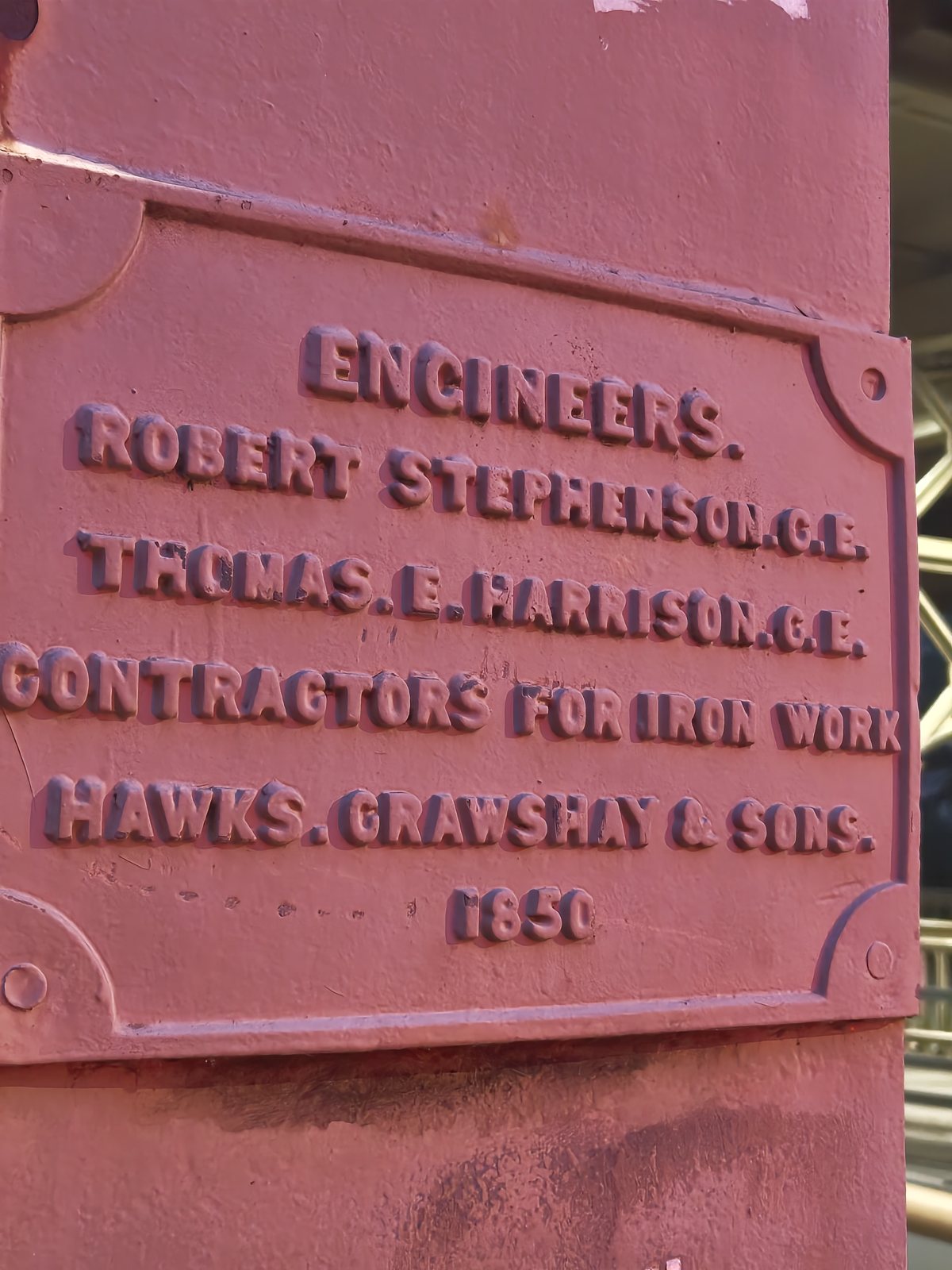
Both plaques are on a pillar at the south (Gateshead) end, beside the western footway. The original, dated 1850, names the engineers and the ironfounders; it went up when the roadway opened. Gateshead Council’s history board, which much of this page draws on, stands at the same entrance.
Changes and restoration
The bridge has been strengthened as the traffic grew. When locomotives had become three times heavier than those it was built for, riveted steel “swan neck” girders were added to the main span girders, with extra columns elsewhere. In the 1920s steel hangers were added between the columns so that trams could run on the road deck. In the 1950s the timber rail deck was replaced with a ballasted steel one, and in 1991 its three tracks were cut to two.
The biggest programme came between 2001 and 2008: £42 million of repair, strengthening and repainting by Network Rail. Cracks found in some of the iron girders closed the road deck in 2005; the timber supports under the road were replaced, the ironwork repaired and repainted, and the lamps restored. When the road reopened in 2008 it was buses and taxis only, southbound. The work won a Europa Nostra Grand Prize for conservation in 2009. The plaque from that restoration is on the same pillar as the 1850 one.
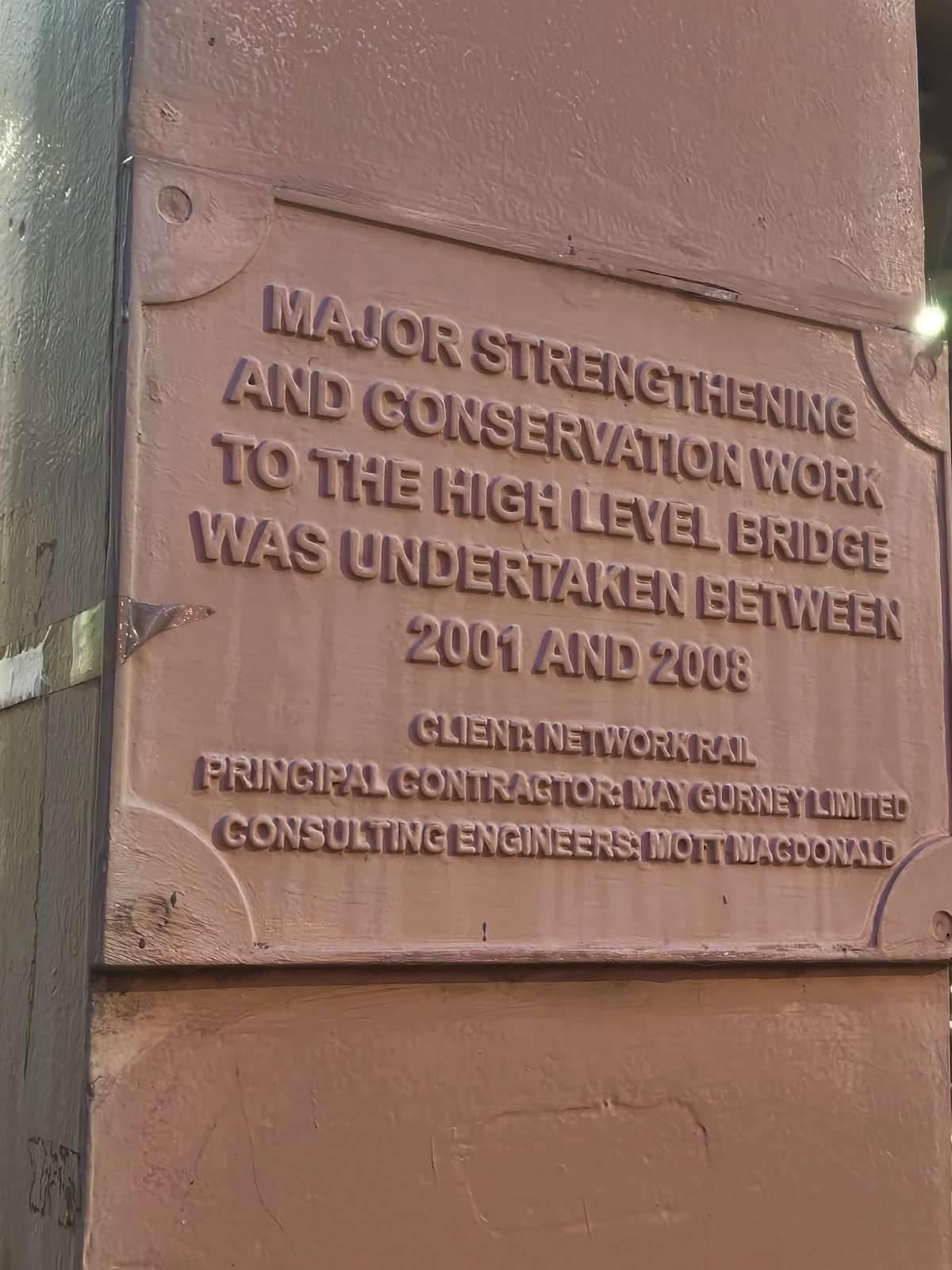
A further £5.2 million refurbishment by Network Rail and AmcoGiffen finished in July 2024: grit-blasting and repainting 283 beams across the six spans, repairs to the wrought iron at road and footway level, and new waterproofing, drainage and road surface.
The bridge is one of the best places to watch the sun come up over the river; see Views from here.
- Network Rail — The history of the High Level Bridge, Newcastle
- Network Rail — £5.2m upgrade complete for Tyneside's 'world-first' railway bridge (25 July 2024)
- Wikipedia — High Level Bridge, River Tyne
- Cast-iron plaques on the bridge, photographed by Andy, September 2026
- Gateshead Council and Network Rail history board, The High Level Bridge, at the south entrance (photographed by Andy, 27 September 2026)
- Andy, on the ground, 27 September 2026 (photographs, plaque location, maintenance status)