Area and history
Greenesfield
Ochre Yards stands on the plateau of the North Eastern Railway's Greenesfield works, Tyneside's first main passenger terminus and later its locomotive headquarters. The streets and blocks are named after the men who ran it and the engines they built.
Last checked · Report a correction
The railway town
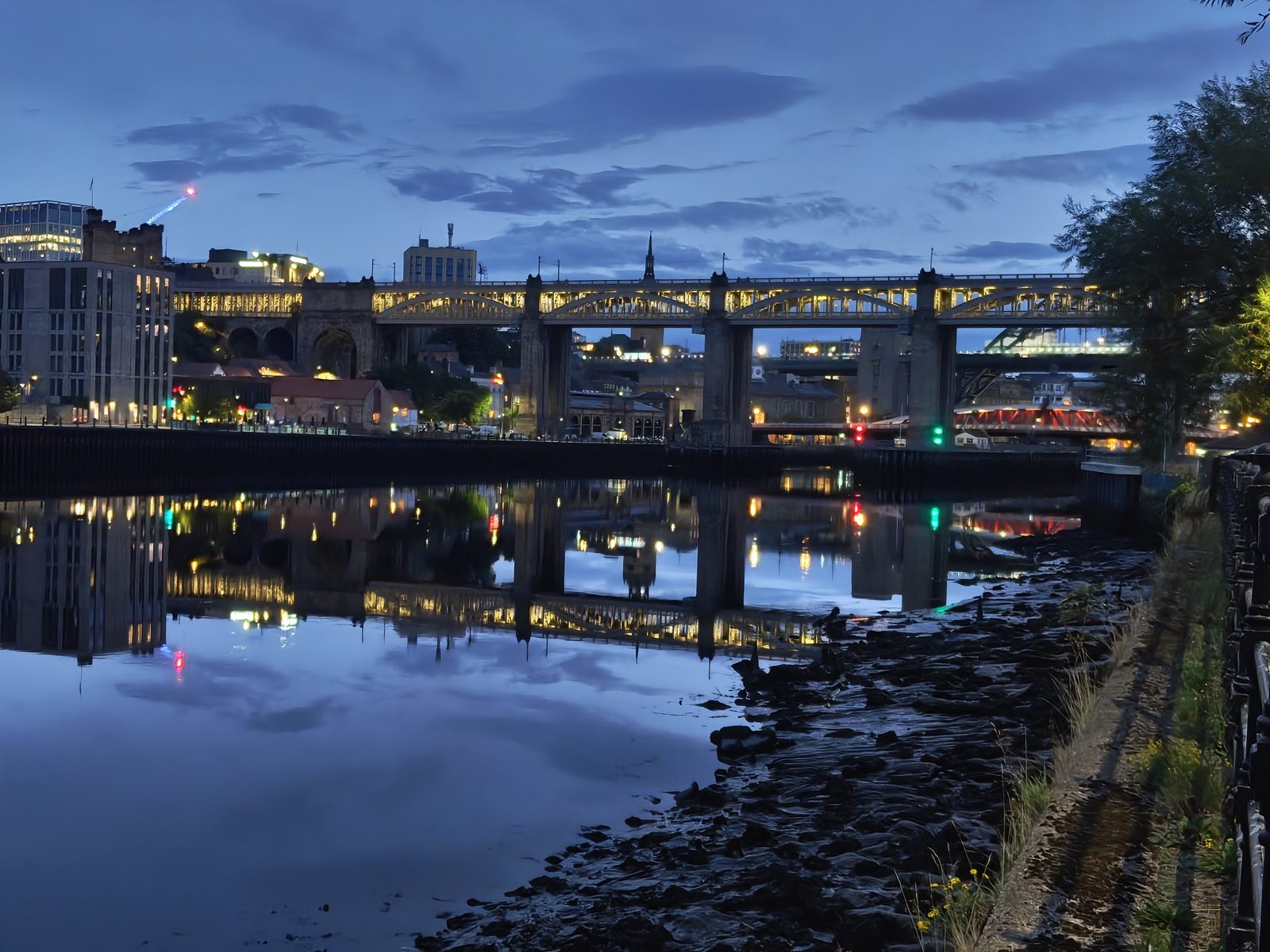
Gateshead was one of the first railway towns. The Newcastle and Carlisle Railway arrived in 1837, ending at Redheugh, and the Brandling Junction Railway in 1839, ending at Oakwellgate. Later in 1839 a line joined the two, including a half-mile viaduct running east–west through the town centre: the arches that still line Askew Road and Wellington Street. In June 1844 Gateshead was a stop on the first full run of the East Coast line from Euston, a journey of nine and a half hours. Greenesfield was the Tyneside terminus of that main line; until 1849 passengers for Newcastle went on by ferry or walked over the old Tyne Bridge.
The High Level Bridge changed the town twice over. Some 130 families were moved and their houses demolished to make way for it and its approach lines, and the iron, more than 5,000 tons, came from Hawks, Crawshay and Sons, a Gateshead firm founded in 1748. Once trains could run straight through to Newcastle, the riverside at Pipewellgate lost its trade and the redundant Greenesfield station became an engine works. In 1867 the old Town Hall was demolished for the Team Valley Extension Railway, the western approach to the High Level Bridge; Gateshead West station opened at the junction in 1868, and a grander Town Hall on West Street in 1870. Gateshead East station followed in 1887.
Both Gateshead stations appear on the North Eastern Railway’s tile maps, the great wall maps of glazed tiles, about 1.7 metres across, that the company put up at its main stations from 1900. Craven Dunnill of Jackfield in Shropshire made them. How many is disputed: the information board beside the Morpeth map says 70, put up between 1900 and 1910, while historians count far fewer: 23 in Newcastle University’s Co-Curate list, about 25 in other accounts. Around a dozen originals survive, most still on their station walls, including Morpeth, Tynemouth and York. Newcastle Central’s went to the railway museum at York. The nearest original to Gateshead is in the old station at Tynemouth; nearer still, a half-size replica went up at Blaydon station in 2026, put up by the Friends of Blaydon Station beside their Blaydon Races mural. On the Morpeth map the NER’s lines are drawn in burnt sienna, and in the Tyneside corner Gateshead East and Gateshead West sit together just south of the river, beside the knot of lines at Central where the railway crosses the river.
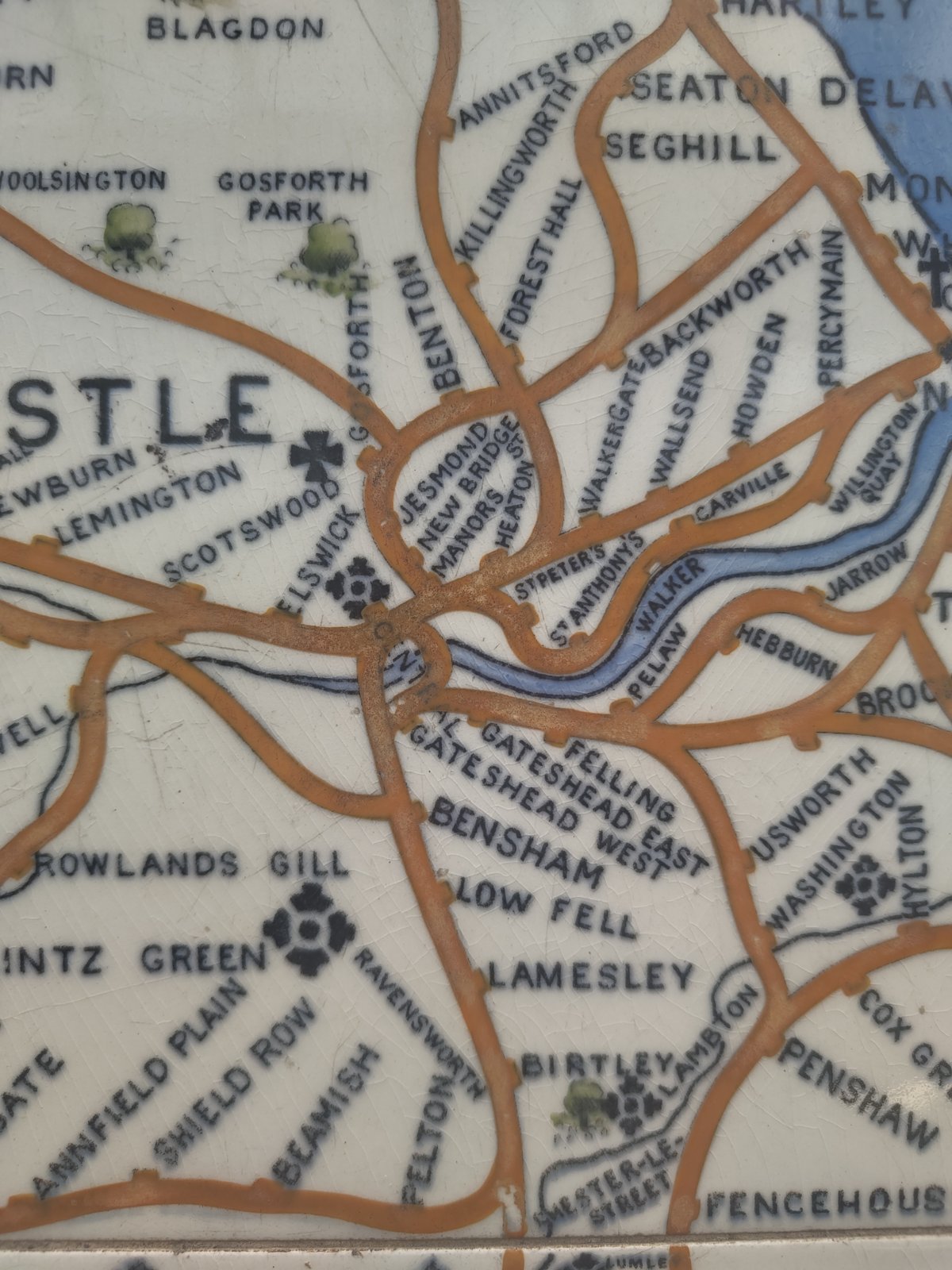
The Tyneside corner of the NER tile map at Morpeth station, put up about 1900: Gateshead East and Gateshead West just south of the river. October 2026.
The King Edward VII Bridge of 1906 took the main line away. Gateshead West closed in 1965, and Gateshead East was demolished soon after the Metro opened; its platforms can still be seen from Hudson Street. The three lines between the two bridges and Oakwellgate form what the council calls the Railway Triangle, the shape the estate sits inside. The area became a conservation area in 1991, and a Townscape Heritage Initiative between 2004 and 2010 brought many of its old buildings back into use. The council’s information board by the MacCoy Fountain on Wellington Street tells the story with old photographs; it adds that The Central is nicknamed the Coffin for the wedge shape the railway lines forced on it.
The works
The railway bought the land from a Mr Greene, hence Greenesfield. The 1844 station building and hotel by G.J. Andrew survive, Grade II listed. Passenger traffic left when the High Level Bridge opened in 1849; from 1854 the site was the NER’s locomotive headquarters. Locomotive building ended in 1910, repairs in 1932 (reopened for wartime overhauls), the works closed in 1959 and the diesel depot in 1991. Demolition came in 2002, and Bellway’s Ochre Yards followed from 2003.
The first town hall
Gateshead became a borough in 1835, and its new council met at first in rented rooms, including part of the Bush Inn on Oakwellgate. In 1844 it bought a house at Greenesfield, beside the new station, and turned it into the Town Hall (the Historic Environment Record describes a new building instead; the books it cites should settle it). Whellan’s directory of 1855 places it “in Half Moon Lane, near the south end of the High Level Bridge”, with the council chamber, police court, borough offices and county court under one roof: roughly where the railway now runs between Kenilworth House and Worsdell House. It stood in the way of the Team Valley Extension Railway, and in 1867 the council had to give the site up to the North Eastern Railway. It met in temporary rooms until the new Town Hall on West Street, by John Johnstone, was finished in 1870. We have found no picture of the Half Moon Lane building; if you know of one, tell us. Don’t confuse it with the other Greenesfield House, the villa on Mulgrave Terrace where Vincent Raven lodged, which later became the council’s health department (see Greenesfield Business Centre).
Field, 1996
For the whole of March 1996, a former railway shed on the works site held Antony Gormley’s Field for the British Isles: about 40,000 hand-sized clay figures, each with eyes, made in 1993 by volunteers working from a heap of brick clay, and filling the floor so that every figure faces the visitor. It had won the 1994 Turner Prize as part of Gormley’s show at the Tate. Gormley’s own record calls Greenesfield the first time the work was shown outside a gallery, and its first showing since the Arts Council Collection bought it in 1995. It was not seen in the North East again until 2021, at the National Glass Centre in Sunderland. It came in the UK Year of Visual Arts, and is said to have drawn more than 25,000 visitors; a 2018 study of the Angel of the North’s setting credits it with helping to win the public round to the Angel. A second show at the works, Angel Models, put Gormley’s models for the Angel on view, reportedly in 1997, before the sculpture went up in February 1998. We haven’t yet found which shed held Field: most of the works came down in 2002, but the former Boiler Shop survives as Ochre Mews. See Gormley’s page for the Gateshead show; we don’t show photographs of the installation here, as the work is his copyright. If you saw it and remember where it was, tell us.
The Arts Council Collection’s short film has Gormley talking about the work and how it was made in 1993, with about 100 volunteers at a school in St Helens, Merseyside (4½ minutes; it shows the work, not the Gateshead showing):
Play “Antony Gormley: Field for the British Isles” (Arts Council Collection, 2020). Loads YouTube.
People of Greenesfield
| Dates | At Greenesfield | |
|---|---|---|
| Edward Fletcher | 1807–1889 | NER Locomotive Superintendent 1854–1882; apprenticed to George Stephenson and worked on Rocket. Fletcher Road |
| Thomas William Worsdell | 1838–1916 | Locomotive Superintendent 1885–1890; compound locomotive pioneer. Worsdell Drive |
| Wilson Worsdell | 1850–1920 | Locomotive Superintendent 1890–1910; electrified North Tyneside in 1904. Worsdell Drive |
| Sir Vincent Raven | 1858–1934 | Pupil under Fletcher from 1877; last Chief Mechanical Engineer 1910–1922. Raven Road, the New Eden House plaque, Raven House |
The chain is the story: Fletcher trained Raven, Wilson Worsdell promoted him, and Raven closed the line of Greenesfield chiefs when locomotive work moved to Darlington in 1910. Alexander McDonnell (1882–85) sits between Fletcher and T.W. Worsdell but has no street.
Block names
Ten of the blocks carry the names of express locomotives, and the pattern is more particular than “LNER names”: nine of the ten were engines allocated to Gateshead shed, 52A, the depot on the works site below the estate. Four are Peppercorn A1s that were new to Gateshead in 1948–49 and stayed a decade or more — Kenilworth, Marmion, Midlothian and Willbrook, the first three named from Sir Walter Scott, the last after a racehorse. Bittern is a Gresley A4 streamliner that spent twenty years at Gateshead from 1943 and survives in preservation. Trigo, Fairway, Cameronian and Tranquil are Gresley A3s named after racehorses — Trigo delivered new to Gateshead in 1930, the others on the shed’s books in the 1960s. Only Colombo, another racehorse A3, has no Gateshead allocation found yet. Each block’s page gives the engine’s number, dates and fate. Liscio, Intento and Motivo are the three blocks Bellway marketed as Modello; The Boiler Shop and Ochre Mews are named for what they were.
Listed buildings
Five listed buildings stand inside the district, from the Grade II former Boiler Shop that is now Ochre Mews to The Central and a former public convenience by the Tyne Bridge, and four listed bridges meet it at the river, the High Level Bridge at Grade I. Listed buildings has each one, its grade and its official entry. The bridges tells the story of the crossings, from Hadrian’s bridge to the Millennium Bridge.
Blue plaques within a walk
Raven (New Eden House, 2011), the High Level Bridge and its restored lamps (central pier, 2008), the Tyne Bridge’s 75th anniversary (2003), the 1854 Fire (2004) and Daniel Defoe (1995) at Hillgate, the River Police Station by the Swing Bridge (1986) and Geordie Ridley on High Street (1995). The Raven trail links most of them.
- North Eastern Railway tile maps — Wikipedia (makers, numbers, surviving maps)
- Co-Curate (Newcastle University) — NER tile map: 23 made, about 1903, Craven, Dunnill & Co
- Tyne Valley Community Rail Partnership — NER tiled map installed at Blaydon railway station (2026)
- NER tile map at Morpeth station, and the station's information board 'Dunnil Enamelled Map' (70 maps, 1900–10), photographed by Andy, October 2026
- Gateshead TMD — Wikipedia
- P+HS Architects — Ochre Yards
- Gateshead Council information board, 'Gateshead – An Early Railway Town', Wellington Street (photographed September 2026)
- List of Gateshead blue plaques — Wikipedia
- Antony Gormley — Field for the British Isles, Greenesfield BR Works, Gateshead, 1–31 March 1996
- Arts Council Collection — Field for the British Isles by Antony Gormley
- Tyne and Wear HER 5612 — Town Hall, Greenesfield
- Tyne and Wear HER 7863 — Bush Inn, Oakwellgate (the council's first rooms, 1836)
- Tyne and Wear HER 8316 — Town Hall, West Street
- Whellan, Directory of Durham, 1855 — public and civil buildings in Gateshead (Co-Curate transcription)
- Sunniside Local History Society — Gateshead (the 1844 purchase and the 1867 demolition)
- North of England Civic Trust — Angel of the North setting study, 2018 (Field 'in a former railway shed at Greenesfield')
- Sunderland Culture — Field for the British Isles coming to Sunderland, 2021 (more than 25,000 visitors in 1996)
- Arts Council Collection — Antony Gormley: Field for the British Isles (film, YouTube, 2020)
- Arts Council Collection — Field for the British Isles to go to Sunderland (2021)