History
The bridges
Seven bridges cross the Tyne between Gateshead and Newcastle in little more than a mile, and four of them meet the district at the river. The lowest crossing, where the Swing Bridge is now, has carried a bridge on and off for nearly 1,900 years.
Last checked · Report a correction
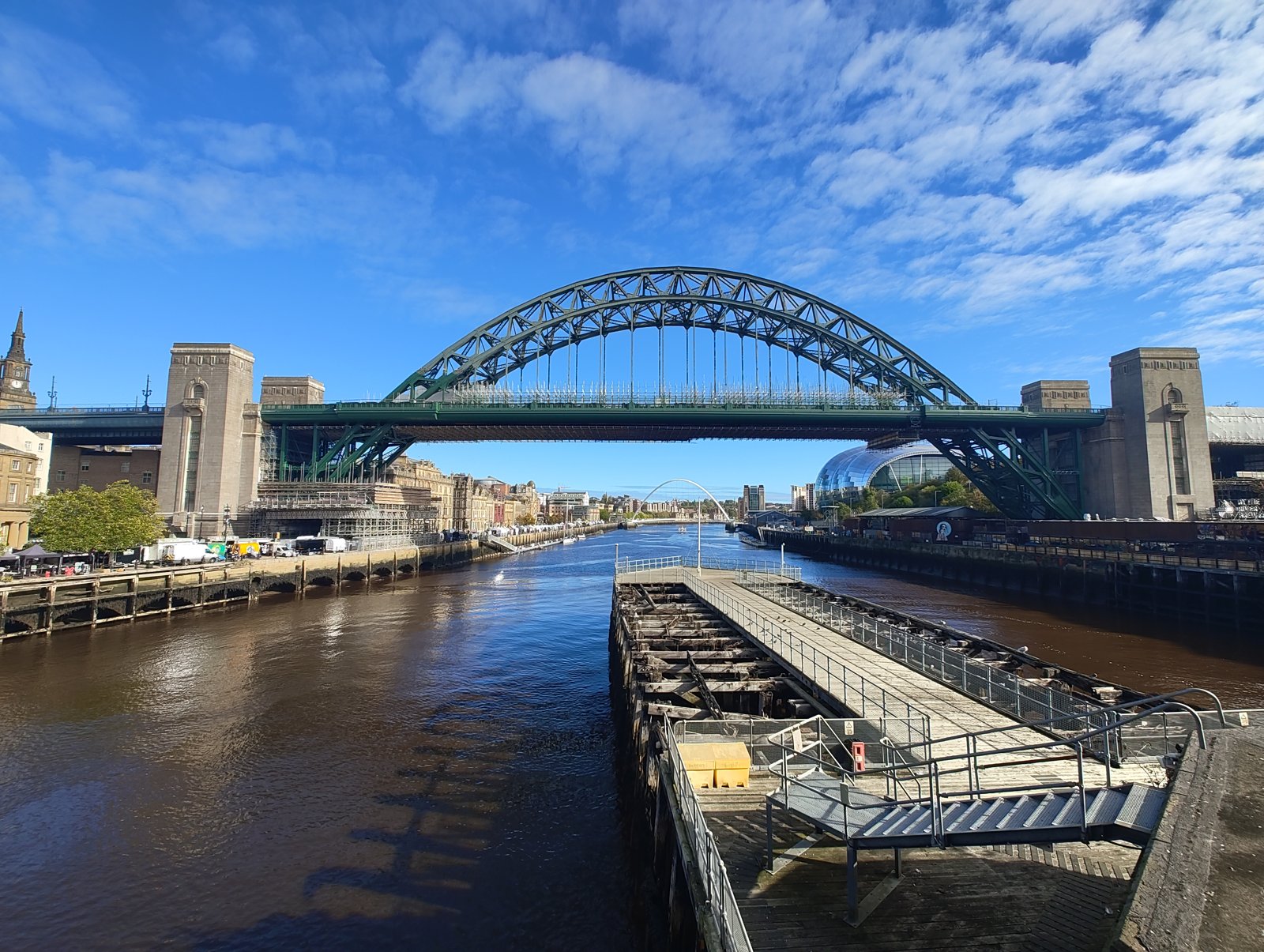
Seven bridges cross between the two towns in little more than a mile: from downstream, the Millennium Bridge, the Tyne Bridge, the Swing Bridge, the High Level Bridge, the Queen Elizabeth II Metro Bridge, the King Edward VII Bridge and the Redheugh Bridge. The district’s riverside runs from the King Edward VII Bridge to the Swing Bridge. For closures and works on the bridges now, see Bridge works; for their listing grades, Listed buildings.
The Roman bridge
Newcastle’s Roman name, Pons Aelius, means the bridge of Hadrian (Aelius was his family name). The bridge was probably built about AD 122, when the Sixth Legion arrived in Britain to build Hadrian’s Wall. Its exact line is not known: the Historic Environment Record calls it “uncertain, but widely believed to be on or in the vicinity of” the Swing Bridge. Nothing of it can be seen. Bridges excavated further along the Wall, at Chesters and Willowford, had stone arches, so WallQuest’s board suggests this one did too, rather than the timber deck once assumed.
When the old bridge’s piers were taken out for the Swing Bridge in 1872, the antiquary John Collingwood Bruce recorded timber piles he took to be Roman, medieval and Georgian; souvenirs and furniture were made from the wood. Some at least were medieval. The board says a radiocarbon date from one pile, obtained by the WallQuest community archaeology project (about 2013–16), “now proves that the Roman bridge was on the same site as the medieval and the swing bridges”. We haven’t found the published date or report, and a museum paper from the same project suggests the “Roman” piles may all have been medieval, so we treat the site as likely rather than proven. If you know where the result was published, tell us.
The river has given up three Roman stones from the north channel at the Swing Bridge, all now in the Great North Museum: Hancock:
- an altar to Neptune, set up by the Sixth Legion, found in 1875 while the Swing Bridge was being built (its base turned up in 1903);
- a matching altar to Oceanus, also the Sixth Legion’s, found in 1903;
- a slab dredged up in 1903, dedicated to the emperor Antoninus Pius by a detachment from three legions, the Second, Sixth and Twentieth, under the governor Julius Verus, so about AD 155–159. Its last lines mention the two German provinces; the board reads it as soldiers arriving by sea from Germany, but how those lines should be read is still argued over.
Altars to the gods of the sea fit a legion that had just made the crossing to Britain; the board points to the anchor carved on the altar to Oceanus.
Roman Gateshead
At the Gateshead end of the bridge a small settlement grew up along the road down to the river. Roman layers were first found in 1994 on the west side of Bottle Bank, and trial digs followed up to 1998; the main excavation, by Oxford Archaeology North in 2000, came before the Hilton was built on the site. It found the remains of stone buildings, stone-lined cisterns, ditches and a stretch of paved road, with pottery mostly of the late 2nd and 3rd centuries. The road, a 3rd-century side track, roughly follows the line of the medieval Mirk Lane. The board describes the settlement as roadside shops and temples living off the traffic to the bridge; the excavation record is more cautious about what the buildings were.
The medieval bridge
The fire of 1248 that destroyed much of Newcastle took the timber bridge with it, and a stone bridge followed, paid for with indulgences and gifts; the Historic Environment Record thinks a stone bridge may already have been started in the late 12th century. The Bishop of Durham, who held Gateshead, was responsible for a third of it, and the Blue Stone set into the roadway marked where his territory ended and Newcastle’s began. It had twelve arches, houses and shops along it, a tower with a portcullis and drawbridge at the Gateshead end and another in the middle, and from 1636 the Magazine Gate at the Newcastle end, where the chapel of St Thomas the Martyr stood.
The river rose through the night of 16 November 1771, and at about 3 o’clock on the morning of the 17th the middle arch and two arches near the Gateshead side gave way. Houses on the bridge went into the river; six people died in Newcastle that night, among them a Mr Fiddas and his maidservant, swept off the bridge. One land arch of the medieval bridge still survives under the Swing Bridge, scheduled and listed Grade I.
The Georgian bridge
A temporary timber bridge opened on 27 October 1772. The new stone bridge, of nine arches, was again built in two parts: Robert Mylne designed the Bishop’s share, whose first stone was laid on 14 October 1774, and John Wooler the Corporation’s, begun the next April. It was in use by 1781, when the temporary bridge came down, and was widened between 1801 and 1818. Its low arches stopped ships going upriver, and from 1868 it was taken down for the Swing Bridge; its last piers came out in 1872.
The Swing Bridge
The Tyne Improvement Commission, set up under an Act of 1861 to open the upper river to sea-going ships, commissioned the Swing Bridge from W. G. Armstrong & Co., whose Elswick works upriver designed it, built the ironwork and the hydraulic machinery that turns it, and paid for the superstructure. Work on the crossing began on 23 September 1868 with clearing the old bridge; the anniversary board at the Gateshead end dates the start of Armstrong’s bridge itself to 1873. It opened to road traffic, without ceremony, on 15 June 1876. The first swing came on 17 July 1876, to let through the Italian ship Europa, on her way to collect a 100-tonne gun Armstrong’s had made for the Italian government; the eyewitness James Clephan wrote that the roadway parted “silent as the stars”. Armstrong’s could now build warships above the bridge and send them to sea through it.
It is 170.68 metres long in six spans. The two middle spans, 85.64 metres and about 1,300 tonnes, turn together on 42 rollers around the centre pier, where a hydraulic press lifts some 900 tonnes of the weight while it swings; the bridge is driven from the cupola on top, turns 90 degrees to let a ship through, and takes about six minutes to go the full 180. Ships heading upriver used the northern channel and ships heading down the southern. The pumps were electrified in 1959, but Armstrong’s own engines still turn it. Its busiest year was 1924, with around 6,000 swings; between the first opening and the end of 1981 it swung 286,281 times and let through about 448,000 vessels. The largest ever was the MV Fernmount, 5,000 tonnes net, in 1952.
It is listed Grade II*. The anniversary board puts its last swing in 2019, when commercial shipping upriver came to an end. Reports in 2021 said an attempt to swing it that August jammed, and in early 2026 that the Port of Tyne and the two councils were looking at how to repair it. If it moves again, tell us.
The riverside at its Gateshead foot is the start of the district: the River Police Station plaque, Lock and Quay the WallQuest board and the 150th anniversary board are all within a few steps.
The others, in order
- High Level Bridge, Robert Stephenson with T. E. Harrison: first trains on 15 August 1849, opened by Queen Victoria on 28 September 1849, road traffic from 4 February 1850. Grade I. Its own page: High Level Bridge.
- Redheugh Bridge: three in turn on the same crossing, Thomas Bouch’s of 1868–70 (often given as opened in 1871), Sir William Arrol’s of 13 August 1901, and today’s, opened on 18 May 1983 by the Princess of Wales.
- King Edward VII Bridge, Charles Harrison, built by Cleveland Bridge & Engineering: opened by the King on 10 July 1906, taking the main line off the High Level Bridge. Grade II.
- Tyne Bridge, Mott, Hay & Anderson, built by Dorman Long, with R. Burns Dick as architect of the granite towers: opened by King George V on 10 October 1928. Grade II*. Its restoration is under way: see Bridge works.
- Queen Elizabeth II Metro Bridge: finished on 1 August 1978, opened by the Queen on 6 November 1981.
- Gateshead Millennium Bridge, Wilkinson Eyre, built by Harbour and General: lifted into place on 20 November 2000, opened to the public on 17 September 2001, and officially opened by the Queen on 7 May 2002.
- WallQuest information board, 'The Roman Bridge across the Tyne at Gateshead', corner of Bridge Street and Hillgate (photographed by Andy, October 2026)
- WallQuest walking guide (text by Nick Hodgson), p. 12 — North East Museums
- Tyne and Wear HER 450 — Roman bridge, Pons Aelius
- Roman Inscriptions of Britain 1319 — altar to Neptune
- Roman Inscriptions of Britain 1320 — altar to Oceanus
- Roman Inscriptions of Britain 1322 — slab of the legionary detachment, AD 155–159
- Croom & Wightman, 'Roman bridge souvenirs' (draft, Tyne & Wear Archives & Museums, 2014)
- Tyne and Wear HER 5633 — Roman bridgehead settlement, Bottle Bank
- Tyne and Wear HER 13525 — Roman road, Hilton Hotel site
- Tyne and Wear HER 310 — medieval Tyne Bridge
- Mackenzie, Historical Account of Newcastle upon Tyne (1827), the bridges — British History Online
- North East Museums — The night the Tyne Bridge fell
- Newcastle Libraries Local Studies Factsheet 1, Bridges (2009)
- '150 Years of the Swing Bridge' board, Port of Tyne, Newcastle City Council and Gateshead Council, 2026 (photographed by Andy, October 2026)
- Tyne and Wear HER 1003 — Swing Bridge
- Bridge Design & Engineering — petition on the Swing Bridge's restoration (10 February 2026)
- IHBC NewsBlogs — the Swing Bridge at 150 (3 March 2026)
- Tyne and Wear HER 1581 — Tyne Bridge
- Tyne and Wear HER 4316 — Redheugh Bridge